
 Unless you
have been living in a wilderness cave, by now you likely have seen Frozen, Disney's most recent animated movie;
if somehow you missed the movie, you have at least seen the numerous videos
circulating around the world of parents lipsynching songs or weathermen parodies. Frozen quickly became the
highest grossing animated film of all time, grossing nearly $400 million in
Unless you
have been living in a wilderness cave, by now you likely have seen Frozen, Disney's most recent animated movie;
if somehow you missed the movie, you have at least seen the numerous videos
circulating around the world of parents lipsynching songs or weathermen parodies. Frozen quickly became the
highest grossing animated film of all time, grossing nearly $400 million in
On the
surface, Frozen is about two sisters:
Elsa, the elder of the two who has unwanted magical powers which she cannot
hide; and Anna, the younger, more carefree and innocent of the two. Elsa, after
years of hiding her powers and being what she calls "the good girl I have
to be", finally gives in and embraces her magical powers: what humanists
might call realizing "who she truly is" or the embracing the
"real" her. Elsa, in a selfish emotional breakdown, forsakes the
kingdom she is supposed to be leading and retreats to the mountains to live
alone, leaving in her wake a land covered in an eternal and deadly winter. When
Anna bravely treks up the mountain to bring her back, Elsa's self-indulgence
takes a fatal turn and her magic freezes Anna's heart. In a race to save their
friend, Kristoff and Olaf whisk Anna away to a troll shaman, who tells them
only an "act of true love" can save Anna.
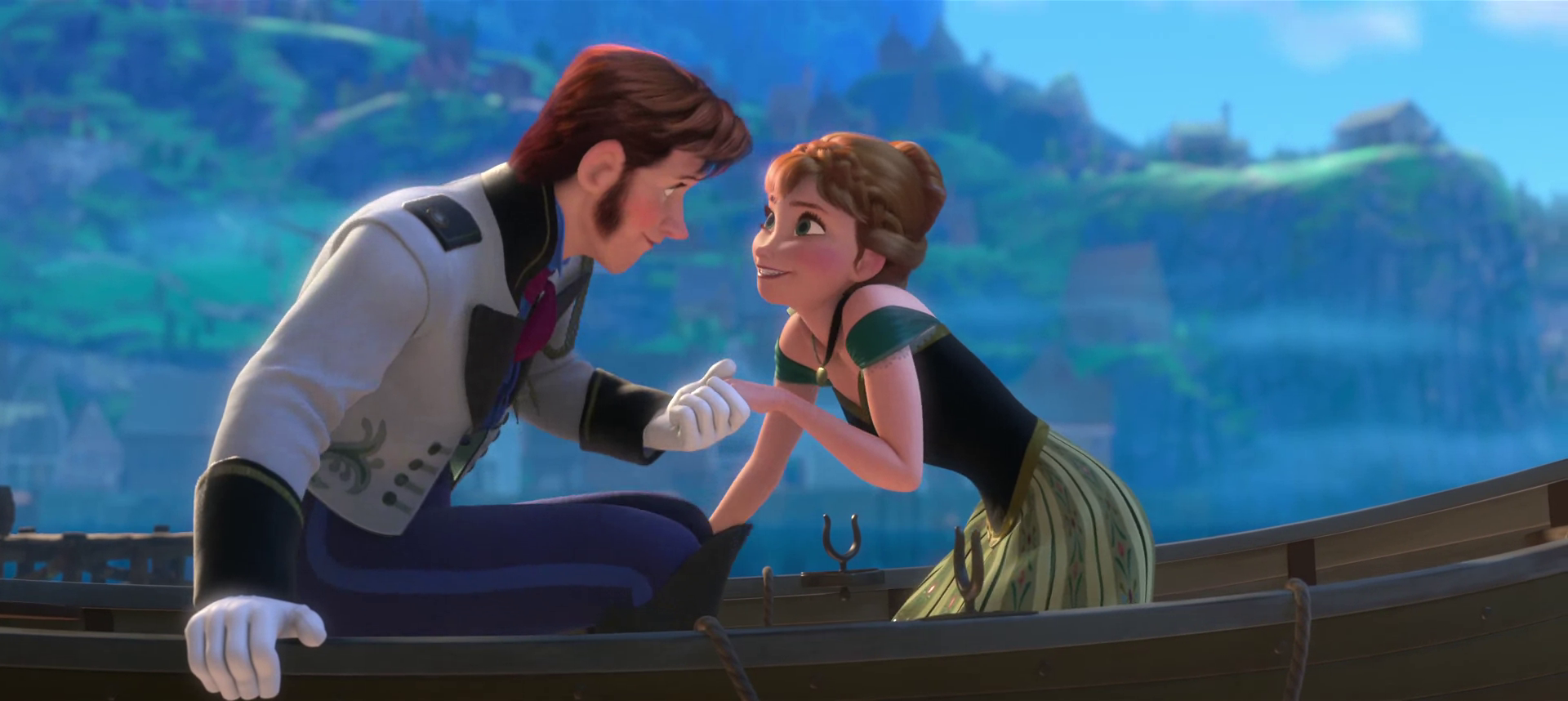 This is the
point in the movie where things get wonderfully relevant for Christians.
Kristoff and Olaf immediately assume the shaman means "an act of amor" - that is, an act of romance - and as such they rush to Hans,
Prince of the Southern Isles, the antagonist of the story, whom they mistakenly
assume to be Anna's "true love". They deliver Anna to Hans, who
reveals himself as a villain, confesses he never actually "loved"
Anna, but feigned love to get to the throne of Arendelle. Hans leaves Anna
to die of a frozen heart, and the situation for Anna looks bleak. Hoping to
survive, Anna and Olaf the Snowman go out into the storm to search for
Kristoff, hoping a kiss from him can thaw Anna's frozen heart.
This is the
point in the movie where things get wonderfully relevant for Christians.
Kristoff and Olaf immediately assume the shaman means "an act of amor" - that is, an act of romance - and as such they rush to Hans,
Prince of the Southern Isles, the antagonist of the story, whom they mistakenly
assume to be Anna's "true love". They deliver Anna to Hans, who
reveals himself as a villain, confesses he never actually "loved"
Anna, but feigned love to get to the throne of Arendelle. Hans leaves Anna
to die of a frozen heart, and the situation for Anna looks bleak. Hoping to
survive, Anna and Olaf the Snowman go out into the storm to search for
Kristoff, hoping a kiss from him can thaw Anna's frozen heart. The climax
of the movie occurs as Anna, near death, stumbles across the frozen fjord and
spies Kristoff racing towards her in the distance. Out of the corner of her
eye, Anna sees Hans about to murder an unsuspecting Elsa. In a moment of
indecision, Anna is torn between hurrying to Kristoff and kissing him, securing
for herself the "act of true love" that will save her, or rushing to
save Elsa from Hans' deadly blow. Anna chooses to forsake her "true
love" and any chance of saving her own life, and instead rushes to Elsa's
aid. She throws herself in front of Hans' sword, freezing to the core at the
last second, deflecting the blow and saving Elsa. When Anna's heart begins to
thaw, everyone realizes the self-sacrificing act of Anna casting aside any
chance to save her own life in order to save Elsa, the very person responsible
for Anna's own death, is in fact "the act of true love" that Anna
needed to save her. The movie closes as Elsa realizes that it is this higher,
self-sacrificing form of love that can free the kingdom from the eternal
winter. Elsa gets her kingdom, Anna gets the boy, and Olaf gets his summer.
The climax
of the movie occurs as Anna, near death, stumbles across the frozen fjord and
spies Kristoff racing towards her in the distance. Out of the corner of her
eye, Anna sees Hans about to murder an unsuspecting Elsa. In a moment of
indecision, Anna is torn between hurrying to Kristoff and kissing him, securing
for herself the "act of true love" that will save her, or rushing to
save Elsa from Hans' deadly blow. Anna chooses to forsake her "true
love" and any chance of saving her own life, and instead rushes to Elsa's
aid. She throws herself in front of Hans' sword, freezing to the core at the
last second, deflecting the blow and saving Elsa. When Anna's heart begins to
thaw, everyone realizes the self-sacrificing act of Anna casting aside any
chance to save her own life in order to save Elsa, the very person responsible
for Anna's own death, is in fact "the act of true love" that Anna
needed to save her. The movie closes as Elsa realizes that it is this higher,
self-sacrificing form of love that can free the kingdom from the eternal
winter. Elsa gets her kingdom, Anna gets the boy, and Olaf gets his summer.
While Frozen is wonderfully animated,
humorous, and full of songs endearing to young people, I think it resonates
with viewers for reasons that transcend any of these: there is a deeper story
in the movie that needs to be told. What is more, in this era of polarizing
worldviews, the deeper moral of Frozen
is one that can not only be embraced by Christians, but it is central to
Christianity. The movie provides unbelievable context for presenting people -
young and old alike - with the gospel and discussing another core tenent of the
Christian faith: the primacy of caritas,
or "divine love", over amor,
or "romantic love".
 The plot
twist of the movie works wonderfully because it exploits a mistaken idea that
is at the core of the human condition: the tragically misplaced idea that what
the Romans and Medievalists called amor,
or romantic love, is the highest form of love in the universe. The examples and
evidence of this idea in popular culture span centuries and are everywhere:
from Shakespeare's Romeo and Juliet
and Othello, to Jack and Rose from Titanic, to the sexual liberation
movements of the last 50 years, to the current astronomical divorce rates worldwide.
All point to humanity's willingness to sacrifice anything and everything on the
altar of amor. When Anna and Kristoff
are told that they need "an act of true love" to save Anna, and they
immediately assume that means a kiss from Hans, no one in the audience thinks
twice about it. I mean, why would they? What else is there?
The plot
twist of the movie works wonderfully because it exploits a mistaken idea that
is at the core of the human condition: the tragically misplaced idea that what
the Romans and Medievalists called amor,
or romantic love, is the highest form of love in the universe. The examples and
evidence of this idea in popular culture span centuries and are everywhere:
from Shakespeare's Romeo and Juliet
and Othello, to Jack and Rose from Titanic, to the sexual liberation
movements of the last 50 years, to the current astronomical divorce rates worldwide.
All point to humanity's willingness to sacrifice anything and everything on the
altar of amor. When Anna and Kristoff
are told that they need "an act of true love" to save Anna, and they
immediately assume that means a kiss from Hans, no one in the audience thinks
twice about it. I mean, why would they? What else is there?
The failure of Hans to save Anna works splendidly to show the fragile nature of amor. It is inadequate to sustain or save Anna, even though all the characters, including Anna herself, assume it to be the most powerful force in the world. Amor is not the panacea, the end-all, cure-all that our culture holds it up to be. When people believe it to be, they are all too frequently dashed on the rocks of broken relationships, marriages, and families. Amor was never meant to endure forever; as Lewis points out, would we even want it to? Would not an eternal "newly-wed" stage only succeed in making us insane? How could anyone hope to sustain that level of emotion for years on end? No, again looking to Lewis, amor is only the spark that is meant to get the engine of a marriage running; it must be sustained by something more.
But unbeknownst to many Americans, thankfully there is something beyond amor. Amor is merely one of a small handful of what Lewis calls "natural loves", but something greater remains. For Christians, this reality is readily apparent: the higher form of love, far superior by far than even the most pure example of amor, is whatSt. Jerome called caritas. It is the divine love of God
for us, a love unmerited and yet eternal. First shown by God towards us so that
we might show it to others. Caritas is the love spoken of in Paul's famous
treatise on love found in his first letter to the Corinthians:
But unbeknownst to many Americans, thankfully there is something beyond amor. Amor is merely one of a small handful of what Lewis calls "natural loves", but something greater remains. For Christians, this reality is readily apparent: the higher form of love, far superior by far than even the most pure example of amor, is what
 "Love suffers long and is
kind; love does not envy; love does not parade itself, is not puffed up; does
not behave rudely, does not seek its own, is not provoked, thinks no evil; does
not rejoice in iniquity, but rejoices in the truth; bears
all things, believes all things, hopes all things, endures all things. Love
never fails."
"Love suffers long and is
kind; love does not envy; love does not parade itself, is not puffed up; does
not behave rudely, does not seek its own, is not provoked, thinks no evil; does
not rejoice in iniquity, but rejoices in the truth; bears
all things, believes all things, hopes all things, endures all things. Love
never fails."
For audiences,
the moment Anna chose to forsake amor
and her love of her own self should be a moment of incredible clarity. The
primacy of caritas is brought into
sharp relief when we realize that "an act of true love" is not a
self-indulgent pursuit of amor, but a
self-sacrificing love, independent of all emotion, unfailing and eternal. As
Paul wrote, it is the love found in Christ's death on the Cross while we were yet
sinners. This is "true love". The writers of Frozen either knew this fully or stumbled into it. Either way the
result is the same: Frozen is a movie
that we as Christians can embrace and use as a context to talk to our children
and others about caritas, the love
that never fails.


