Something is wrong. Commitment is a thing of the past. Love that is longsuffering has been replaced by divorce on demand. Charity is dead. We have ceased to instill our children with virtues and then we are shocked that they grow up to be reprobates. Materialism and hedonism are the philosophies of the masses because their education has not empowered them to define either. Our modern world has left us dissatisfied and disillusioned. We search for something lost. Classicism is on the ascendancy.
Showing posts with label Philosophy. Show all posts

Sunday, April 13, 2014

Anna Gets It Right: Disney's Frozen, C.S. Lewis, and the Primacy of Caritas

            Unless you have been living in a wilderness cave, by now you likely have seen Frozen, Disney's most recent animated movie; if somehow you missed the movie, you have at least seen the numerous videos circulating around the world of parents lipsynching songs or weathermen parodies. Frozen quickly became the highest grossing animated film of all time, grossing nearly $400 million in North America alone.
           
            On the surface, Frozen is about two sisters: Elsa, the elder of the two who has unwanted magical powers which she cannot hide; and Anna, the younger, more carefree and innocent of the two. Elsa, after years of hiding her powers and being what she calls "the good girl I have to be", finally gives in and embraces her magical powers: what humanists might call realizing "who she truly is" or the embracing the "real" her. Elsa, in a selfish emotional breakdown, forsakes the kingdom she is supposed to be leading and retreats to the mountains to live alone, leaving in her wake a land covered in an eternal and deadly winter. When Anna bravely treks up the mountain to bring her back, Elsa's self-indulgence takes a fatal turn and her magic freezes Anna's heart. In a race to save their friend, Kristoff and Olaf whisk Anna away to a troll shaman, who tells them only an "act of true love" can save Anna.
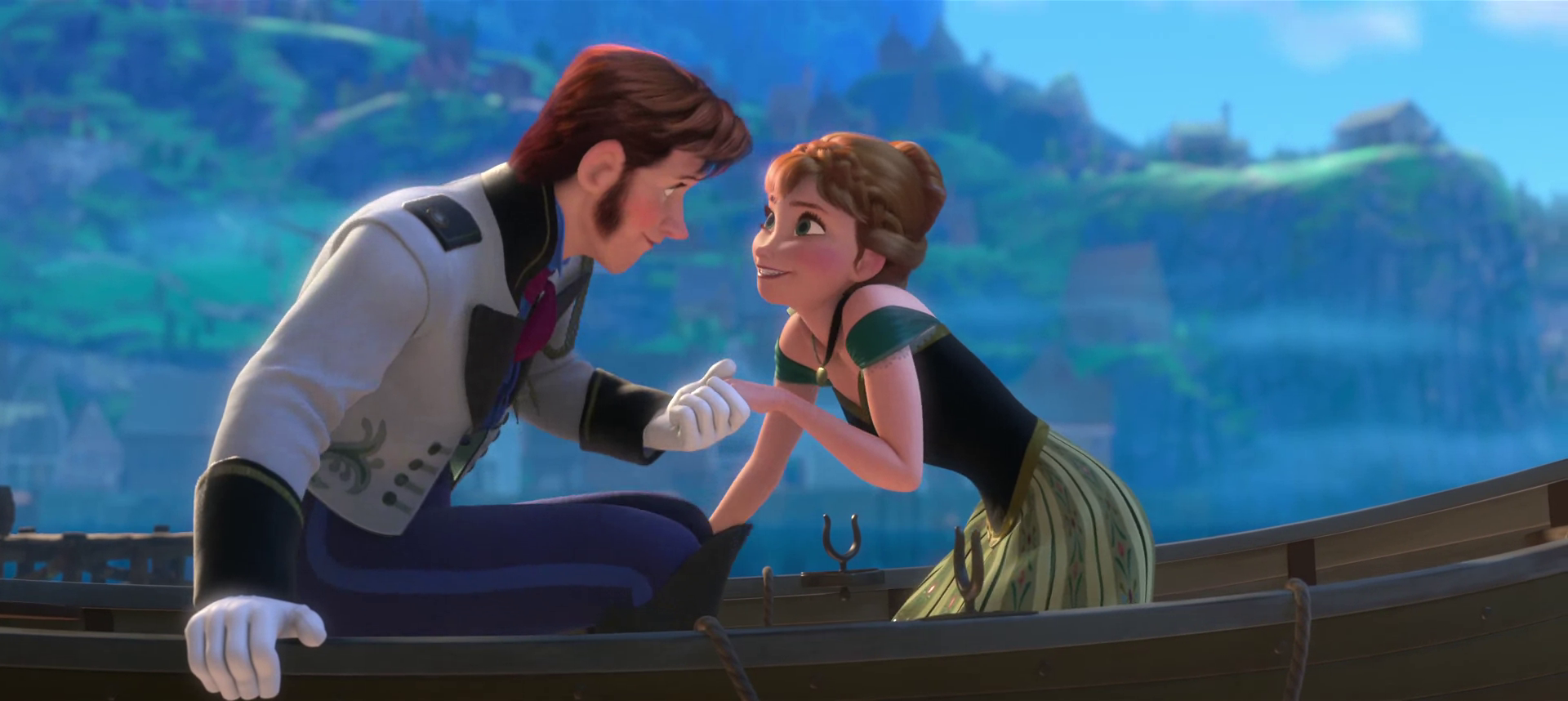
                                       
            This is the point in the movie where things get wonderfully relevant for Christians. Kristoff and Olaf immediately assume the shaman means "an act of amor" - that is, an act of romance - and as such they rush to Hans, Prince of the Southern Isles, the antagonist of the story, whom they mistakenly assume to be Anna's "true love". They deliver Anna to Hans, who reveals himself as a villain, confesses he never actually "loved" Anna, but feigned love to get to the throne of Arendelle. Hans leaves Anna to die of a frozen heart, and the situation for Anna looks bleak. Hoping to survive, Anna and Olaf the Snowman go out into the storm to search for Kristoff, hoping a kiss from him can thaw Anna's frozen heart.

            The climax of the movie occurs as Anna, near death, stumbles across the frozen fjord and spies Kristoff racing towards her in the distance. Out of the corner of her eye, Anna sees Hans about to murder an unsuspecting Elsa. In a moment of indecision, Anna is torn between hurrying to Kristoff and kissing him, securing for herself the "act of true love" that will save her, or rushing to save Elsa from Hans' deadly blow. Anna chooses to forsake her "true love" and any chance of saving her own life, and instead rushes to Elsa's aid. She throws herself in front of Hans' sword, freezing to the core at the last second, deflecting the blow and saving Elsa. When Anna's heart begins to thaw, everyone realizes the self-sacrificing act of Anna casting aside any chance to save her own life in order to save Elsa, the very person responsible for Anna's own death, is in fact "the act of true love" that Anna needed to save her. The movie closes as Elsa realizes that it is this higher, self-sacrificing form of love that can free the kingdom from the eternal winter. Elsa gets her kingdom, Anna gets the boy, and Olaf gets his summer.

            While Frozen is wonderfully animated, humorous, and full of songs endearing to young people, I think it resonates with viewers for reasons that transcend any of these: there is a deeper story in the movie that needs to be told. What is more, in this era of polarizing worldviews, the deeper moral of Frozen is one that can not only be embraced by Christians, but it is central to Christianity. The movie provides unbelievable context for presenting people - young and old alike - with the gospel and discussing another core tenent of the Christian faith: the primacy of caritas, or "divine love", over amor, or "romantic love".

            The plot twist of the movie works wonderfully because it exploits a mistaken idea that is at the core of the human condition: the tragically misplaced idea that what the Romans and Medievalists called amor, or romantic love, is the highest form of love in the universe. The examples and evidence of this idea in popular culture span centuries and are everywhere: from Shakespeare's Romeo and Juliet and Othello, to Jack and Rose from Titanic, to the sexual liberation movements of the last 50 years, to the current astronomical divorce rates worldwide. All point to humanity's willingness to sacrifice anything and everything on the altar of amor. When Anna and Kristoff are told that they need "an act of true love" to save Anna, and they immediately assume that means a kiss from Hans, no one in the audience thinks twice about it. I mean, why would they? What else is there?

          The failure of Hans to save Anna works splendidly to show the fragile nature of amor. It is inadequate to sustain or save Anna, even though all the characters, including Anna herself, assume it to be the most powerful force in the world. Amor is not the panacea, the end-all, cure-all that our culture holds it up to be. When people believe it to be, they are all too frequently dashed on the rocks of broken relationships, marriages, and families. Amor was never meant to endure forever; as Lewis points out, would we even want it to? Would not an eternal "newly-wed" stage only succeed in making us insane? How could anyone hope to sustain that level of emotion for years on end?  No, again looking to Lewis, amor is only the spark that is meant to get the engine of a marriage running; it must be sustained by something more.

          But unbeknownst to many Americans, thankfully there is something beyond amor. Amor is merely one of a small handful of what Lewis calls "natural loves", but something greater remains. For Christians, this reality is readily apparent: the higher form of love, far superior by far than even the most pure example of amor, is what St. Jerome called caritas. It is the divine love of God for us, a love unmerited and yet eternal. First shown by God towards us so that we might show it to others. Caritas is the love spoken of in Paul's famous treatise on love found in his first letter to the Corinthians:

"Love suffers long and is kind; love does not envy; love does not parade itself, is not puffed up; does not behave rudely, does not seek its own, is not provoked, thinks no evil; does not rejoice in iniquity, but rejoices in the truth; bears all things, believes all things, hopes all things, endures all things.  Love never fails."


            For audiences, the moment Anna chose to forsake amor and her love of her own self should be a moment of incredible clarity. The primacy of caritas is brought into sharp relief when we realize that "an act of true love" is not a self-indulgent pursuit of amor, but a self-sacrificing love, independent of all emotion, unfailing and eternal. As Paul wrote, it is the love found in Christ's death on the Cross while we were yet sinners. This is "true love". The writers of Frozen either knew this fully or stumbled into it. Either way the result is the same: Frozen is a movie that we as Christians can embrace and use as a context to talk to our children and others about caritas, the love that never fails.

Friday, July 29, 2011

Where Science Went Wrong: God, Truth, and Ricky Gervais

"Science seeks the truth. And it does not discriminate. For better or worse it finds things out. Science is humble. It knows what it knows and it knows what it doesn’t know. It bases its conclusions and beliefs on hard evidence -­- evidence that is constantly updated and upgraded. It doesn’t get offended when new facts come along. It embraces the body of knowledge."  - Ricky Gervais, "Why I'm an Atheist"

Atheism is in vogue. Celebrity comedian Ricky Gervais has taken up the mantle of atheist apologist and advances his worldview every time his face is in front of a camera. He has had at least two articles published in the Wall Street Journal in the past seven months - one at Christmas and one at Easter, interestingly enough - which both present his "reasoned" (his word, not mine) explanation for not believing in God. As a host of the Golden Globe ceremony earlier this year, Mr. Gervais ended his closing monologue with the memorable if unspectacular line "Thank you to God for making me an atheist." Mr. Gervais has had a nice tour hitting all the talk shows to deride theists and posture himself as a logical and enlightened atheist.

But what is Mr. Gervais really saying, and is he the enlightened erudite that he pretends to be? Let's first analyze his arguments for his disbelief in God. He uses a lot of space to say very little: "Science seeks the truth.... For better or worse it finds things out.... It bases its conclusions... on hard evidence." What does all this mean? Mr. Gervais is implying that science and theism diverge, but where and why? Mr. Gervais has very little to say here, only some empty platitudes about evolution and "truth, science, and nature." Mr. Gervais would have us accept prima facie - as self-evident and not requiring further argument - that evolution (and science and nature) and theism are mutually exclusive; his view is that the two simply cannot coexist in a coherent and rational system of thought. Mr. Gervais wants us to believe that if one person were to accept both evolution and theism as valid explanations of the world, his eyes would cross, his hair catch on fire, his head would turn 360's on his neck Excorcist-style, and his inner gray matter would burst from his ears.

Unfortunately for Mr. Gervais, this is far from the case. Two of the most prolific thinkers of the twentieth century - both countrymen of Mr. Gervais' - fall into this category: theists who were also evolutionists. It was G.K. Chesterton who wrote:

If evolution simply means that a positive thing called an ape turned very slowly into a positive thing called a man, then it is stingless for the most orthodox; for a personal God might just as well do things slowly as quickly, especially if, like the Christian God, he were outside time.[1]

C.S. Lewis, another of Mr. Gervais' countrymen and one of the most profound philosophers and writers of the twentieth century, wrote:

I am not either attacking or defending Evolution. I believe that Christianity can still be believed, even if Evolution is true.... I can’t help regarding [advice that I refute Evolution in all my Christian apologetics] as a temptation to fight the battle on what is really a false issue: and also on terrain very unsuitable for the only weapon I have.[2]

Lewis, not surprisingly, got it right: evolution with regards to theism is a "false issue," a non-starter. As Lewis and Chesterton show, evolution and theism (particularly Christian theism) are entirely compatible. As this author has argued elsewhere, if all that evolutionists hope for could ever actually be proven true, the net result is only truly  problematic for a literal interpretation of the creation account in the opening chapters of Genesis. More specifically, it would be terminal for a literal reading of the duration of the events recorded by the author of Genesis; that is, the "days" recorded by the author would not be literally interpreted as a twenty-four hour period, but instead could be understood to refer to some steps or sequences in the generative process. The rest of the creative narrative remains intact.

Science more broadly is a false issue for additional reasons as well. First, as any junior high school student with a natural science textbook can tell you, science is restricted by that which can be empirically tried and tested. Even the most novice scientist should be intimately familiar with the standard by which scientific knowledge is gathered, tested, and corrected: the scientific method. The steps of that method roughly speaking are:

1. State the problem.
2. Form a testable hypothesis.
3. Design an experiment to test the hypothesis.
4. Collect and analyze data produced by the experiment.
5. Draw conclusions from the analysis.
6. Communicate the results.[3]

To illustrate how the scientific method is supposed to work to arrive at what Mr. Gervais so recklessly calls "facts," let us consider an example. Our hypothetical scientist—let us call him Smee—gets an awful stomach ache after lunch. It doesn't happen every day, but just often enough to make Smee miserable. Smee needs to figure out the cause of the stomach pains and solve it. We have just stated the problem: Smee gets stomach aches after lunch. Smee must now form a hypothesis, but not just any hypothesis will do: it must be testable. He arrives at a hypothesis via observing the evidence: he gets stomach aches, always after lunch, only on occasion; ergo, Smee hypothesizes that something he is eating on occasion for lunch is upsetting his stomach. His next step is to form an experiment to test his hypothesis: he carefully plans and documents a month-long lunch diet where he isolates certain foods to eat on certain days, and he diligently records which days he gets an upset stomach. After the month is up, he collects his diet and his health reports, analyzes them, and finds that his stomach aches only happened on Tuesdays and Thursdays when he ate peanut butter for lunch. Smee's conclusion then: peanut butter upsets his stomach. He compiles his results and conclusions in a nice journal entry to himself so he can use them again later if he runs into any problems.

Now, imagine for a minute this process—the process, remember, by which science is supposed to arrive at Mr. Gervais' "facts"—applied to the existence of God. Step One: our problem is that we are unsure about whether or not God really exists. Step Two: our hypothesis is that God does not exist. Step Three: we need to design an experiment around our hypothesis, which if you remember is supposed to be testable. We have run into our first problem, and it is staggering. How would we go about testing our hypothesis that God does not exist? We could give God an ultimatum by saying, "God, I'm going to jump off this cliff. If you exist, you can save me from a certain death. If you don't exist, you wont' save me," and jump and see what happens. The problem with this experiment is that God, if He exists, is a sentient being who possesses free will, and He might think us foolish and simply choose not to save us. By way of cutting him off at the pass, one can assume Mr. Gervais might try to insert evolutionary theory as some kind of experiment, but that falls short as well. Here is why: in the corporate world, there is a process known as "reverse engineering" by which one company obtains the finished product of a second company and dismantles it to see how it works. Even if evolution is true, all we have done is to reverse engineer God's creation; that is, we have merely figured out how creation and biological processes work. To assert anything more would be akin to the Android engineer who, upon dismantling a new generation iPhone, decides that, because he was able to figure out his creation, the Apple engineer does not exist. His conclusion simply does not follow from his evidence.

Though he did not necessarily articulate it as such, Mr. Gervais is presumably assuming the position of naturalism: the position that the only things which can be known are those which are arrived at via the scientific method. If this is the case, fine and well, but he must be prepared to surrender a good deal of ideas that he considers "truth," most notably his own atheism. As discussed above, atheism - and theism, mind you - are not positions that can be arrived at by way of the scientific method. As such, Mr. Gervais' own atheism is a matter of faith, just like the believer's theism. The two are in the same boat. The only difference appears to be that the theist is more honest about his position with all his talk about "faith" and "belief," while Mr. Gervais' game is to parade his own faith as something more - "truth, science, and nature." We should not be fooled.

If Mr. Gervais would like to make the point that one cannot use science to prove God's existence, then his point would be well-made; but he must also concede that one cannot use science to disprove God's existence, which by my lights is precisely what he purports to do. The problem for Mr. Gervais and other psuedo-scientists like him is that the question of God's existence does not belong to the province of science. It cannot be tested or observed. It cannot be put in a beaker and heated, nor can it be dissolved in a solution and analyzed. The question of God's existence is not a scientific question, it is a philosophical question, and in that realm Mr. Gervais is out of his league. While he is certainly welcome to his opinion, and he is to be admired for his willingness to step into the ring and taking a few swings, he would be well-advised to stick to what he knows. For all his comic genius, Mr. Gervais is a very poor scientist, and an even worse philosopher.

Oh, and I thank God for making me a believer.


[1] G.K. Chestergon, Orthodoxy (Hollywood, FL 2010), p. 29.
[2] Gary Ferngren, et al. "C.S. Lewis on Creation and Evolution: The Acworth Letters, 1944–1960", www.asa3.org/aSA/PSCF/1996/PSCF3-96Ferngren.html. In a reference which immediately calls to mind  Gervais' polemics, Lewis would later write to Acworth, "‘What inclines me now to think you may be right in regarding [evolution] as the central and radical lie in the whole web of falsehood that now governs our lives is not so much your arguments against it as the fanatical and twisted attitudes of its defenders."
[3] These steps were taken from a poster on the wall in a junior high life science classroom.

Friday, February 4, 2011

In Defense of the Humanities

"Medicine, law, business, engineering, these are noble pursuits and necessary to sustain life. But poetry, beauty, romance, love, these are what we stay alive for. To quote from Whitman, "O me! O life!... of the questions of these recurring; of the endless trains of the faithless... of cities filled with the foolish; what good amid these, O me, O life?" Answer. That you are here - that life exists, and identity; that the powerful play goes on and you may contribute a verse.... That the powerful play goes on and you may contribute a verse." Mr. John Keating, Dead Poet's Society


If you watched last week's State of the Union address, you could not help but notice President Obama's heavy emphasis on science, technology, engineering, and math education (or "STEM" for short.) In what he termed our "Sputnik moment", President Obama called for a renewed emphasis on STEM in order to drive invention and create more jobs here in America (in the context of his call last year to train 100,000 new STEM teachers, one might wonder what is "new" about this year's emphasis; but I digress.) In this poor economy, one can excuse the President's focus on creating new jobs for Americans. However, we need to be careful about being overly reactive to the needs of the moment to the detriment of our nation's long-term health, particularly as it pertains to education.[1]

What do I mean? One must look at our system and wonder if our falling math and science scores are at all related to a lack of emphasis on STEM. I propose that they are not. For example, at my alma mater, the largest, newest buildings on campus are the engineering and technology buildings; the oldest and most dilapidated are the liberal arts buildings. The History department is located in a single hallway in the back of the library. You would not even know it was there if you were not looking for it. Need another example? At my university, a rough estimate shows that roughly two-thirds of the students in any given teacher education class are STEM majors. The remaining third are English majors, which if you paid attention in algebra class, you would recognize that does not leave a whole lot of room for the rest of the humanities.

By my lights, we are fully focused on STEM education. We are throwing the kitchen sink at it, and yet, according to our politicians at least, we are lagging behind the competition. So maybe our neglect of STEM is not the problem; perhaps we are administering the wrong medication. Perhaps we are administering penicillin when amoxicillin would do the trick. But if our neglect of STEM is not the problem, then what is? I propose that our focus on STEM is the problem.

If that last statement did not cause you to write me off as a kook and you are still with me, let me explain what I mean. I think most people with some cultural perspective would agree that our young people generally have a motivation problem (not all young people, mind you; just generally speaking.) Who can blame them? They have an unprecedented number of distractions pulling at them: technologies that demand immediate attention and response like smart phones and iPads; increased access to their peers afforded by social networking media; instability in their homes severe enough to incapacitate most adults involved, who are (ideally, at least) better equipped emotionally to handle the instability; immersive video games the likes of which the world has never seen before; romantic relationships with increased sexual activity and the related emotional duress; and all the normal stresses of adolescence like biological changes, balancing school, extracurricular activities, and a social life, etc. It is a lot to expect young people to manage.

On top of all this, we as a society are force-feeding them subjects like chemistry and pre-calculus, subjects that perhaps 2% of the population might use in the course of their life (I made that number up; contest it if you like.) Not that there is anything wrong with these subjects in and of themselves; what I am addressing is the emphasis being placed upon them by our society. I propose that these subjects do not generally cultivate a love of learning. Few things about math and science evoke passion in students to better themselves, to challenge themselves in ways they might not otherwise. They do not necessarily drive students to think critically about important issues of life: love, personal fulfillment, the meaning of happiness, etc. By over emphasizing them, we are in effect running a risk of quashing a love of learning in students that are required to create the captains of industry that our nation so needs. It is part of what Mr. Keating was getting at when he said that they are "necessary to sustain life... but [not] what we stay alive for." Education needs to be a goal in and of itself; students need to be encouraged to pursue an education in order to become a certain kind of person, to find what they "stay alive for."

But what kind of education can provide this kind of self-actualization for students? Students need to be exposed to humanity in a way that I fear is not currently happening: in order to realize their own potential - for both good and evil - students need to be exposed to the great heroes - and villains - of human history. A liberal arts education, one with a strong humanities emphasis, provides the kind of immersion in the human experience requisite for this kind of self-actualization. By reading of Odysseus the man who was never at a loss and of arms and mighty Aeneus, by studying the ethical philosophies of Jesus of Nazareth that changed the course of world history, by examining the genius of Beethoven's 9th Symphony or Shakespeare's sonnets, by learning of the founding of a great nation, by analyzing the diabolical mind of Adolph Hitler and the stalwart defiance of Churchill, and much more, students can come to realize that all of human history is what Mr. Keating described as "a powerful play" in which they too "can contribute a verse." 


[1] None of this should be taken as a partisan political attack on President Obama. I take the Republicans to be equally culpable in what I perceive to be a miscalculation in the purposes of education.

Wednesday, January 19, 2011

The New Tolerance and the Trojan Horse

“It is hard to be sure of anything among so many marvels,” said Eomer. “The world is all grown strange…. How shall a man judge what to do in such times?”

“As he ever has judged,” said Aragorn. “Good and ill have not changed since yesteryear; nor are they one thing among Elves and Dwarves and another among Men. It is a man’s part to discern them, as much in the Golden Wood as in his own house.” J.R.R. Tolkien, The Two Towers

A friend recently posed a fascinating question on an online forum: when does tolerance become moral relativism? Appropriately enough, my friend encountered this question on the campus of a university. As anyone who has spent even the smallest amount of time at a university recently can attest, tolerance is not only the intelligentsia’s favorite moral virtue, it is to them the only moral virtue. They chastise anyone who would impose their value system on someone else, unless that system is tolerance - and only tolerance. And their end-game is to make that value system universal; that is, they want to make it yours, too. Our children are bombarded with tolerance the moment they turn on their television. Schools are increasingly focusing on tolerance and diversity in their curriculum. As political analyst Juan Williams recently discovered, fall out of step for even a moment and your scourging will be public and painful.

What do we mean when we say we expect someone to be tolerant of something? If I ask you if you like the cold weather, and you simply respond that you can “tolerate it”, what have you actually said? Simple analysis reveals a few things: a.) you do not in fact like the cold weather; and b.) you can bear the cold weather if you must; that is, you do not have immediate plans to move to Florida to avoid it. Notice what you have not told me: that cold weather suits you as well as any other weather. In this regards at least, when we speak of tolerance we are not speaking of sympathizing with or affirming someone else’s position, we are only speaking of bearing it. If I tell you that I love the cold, and you say that you can tolerate my enthusiasm for it, you are not saying that you agree with my position that cold weather is grand. You might still prefer warm weather, but you agree to not push me off a cliff for holding a different opinion.

If this classical definition is what it means to be “tolerant” - only that we do not want to do bodily harm to those who hold a worldview opposed to our own - then what should the Christian’s response to these calls for tolerance be? There could be no easier answer for the Christian: we are supposed to go far beyond tolerance. Jesus summed up the greatest commandment into two parts: first, the Christian is to love God with his whole heart; and second, to love your neighbor as yourself. The Greek word translated as “love” here is the verbal form of the Greek word agape, which does not imply sentiment or sexuality, but charity and brotherly-love. We as Christians are to be charitable and kind to our neighbors - everyone that we come into contact with, even if they hold worldviews which oppose our own. Jesus commanded it.

But is this what the academics and social activists mean when they make their familiar calls to “tolerance”? The evidence reveals that it is not. Take the Williams case, for instance. Mr. Williams did not advocate doing bodily harm or imposing draconic restrictions on devout Muslims, and yet he was labeled as a bigot. Think about this: how often have you heard a political commentator, educator, or anyone else define what they mean when they say we should be “tolerant”? Almost never. Any discussion of a definition such as this is almost always lacking. This is most certainly by design. By keeping the definition ambiguous advocates can actually alter the meaning of the word - and the debate - over time and most people are none the wiser for it. A simple survey of the meaning of tolerance would indicate just such a thing has happened. A 1992 Webster’s Dictionary defines tolerance as “readiness to allow others to believe or act as they judge best.” No problems there, right? However, the most recent online Merriam-Webster’s dictionary defines tolerance as “sympathy or indulgence for beliefs or practices differing from or conflicting with one's own .” Notice the shift from “allow[ing]” the views or acts of others to “sympathiz[ing] or with that view or action. The former implies the classical definition of tolerance discussed above while the latter requires something new: not only are we required to “live and let live” to be tolerant, but now there is an expectation to sympathize if not assent.

These linguistic acrobatics must make the Christian wonder what is afoot. Most people are familiar with the  story of the Trojan Horse. Today “Trojan horse” is used in the technological world, but the original Trojan Horse was perhaps the greatest trick in human history. After sieging the ancient city of Troy, the Greeks realized they could not breach the city’s strong walls by force; they therefore created a ruse by which they hoped to trick the Trojans. The Trojans were horse-lovers, so the Greeks crafted a giant wooden horse out of scraps of their own warships. They hid thirty of their own men in the hollow inner spaces of the horse, and left it at the gates of the city as an offering to the Trojans. The Trojans were fooled and welcomed the horse - and the Greeks warriors hidden in its belly - into the city. At night the Greeks exited their hiding place and opened the city gates to their countrymen. Troy was lost, and the Trojans disappeared from history.

We must wonder if we are not now the targets of a similar ruse. The genius of the original Trojan Horse is the Greeks were able to get the Trojans to accept something - Greeks within their own city walls - they never would have accepted under normal conditions. The game seems the same for advocates of the new tolerance: their aim seems to be to get others to accept a thing under the guise of “tolerance’ which they would might never accept otherwise. This takes us back to my friend's original question: where does tolerance and moral relativism intersect? When we no longer are only required to bear others with an opposing worldview in order to be tolerant, but are instead required to sympathize or assent with their worldview - that is, treat it as though it were our own and acknowledge it as valid - than we have ceased to hold or our own worldview in any meaningful way. We have been driven to moral relativism. For example, say I hold the view that marriage is to between two people and you the opposing view that marriage should be between five people. In order to be tolerant in the classical sense, I only need to refrain from punching you in the mouth because you disagree with me. However, under the guise of this new tolerance, I am now required to agree in some vague sense that it is not only acceptable but agreeable for five people to all be married one to another, and I must try to sympathize with how you feel for believing this. In reality, I have only committed to the position that I believe there is no proper form of marriage. I have committed to a free-for-all.

This is dangerous ground. Even advocates of the new tolerance do not want to go where it will eventually take us. They just have not followed their course to its logical conclusion. There was a recent news article that introduced a new word to the English vernacular that we should all prepare to hear more often as the debate about morality takes a linguistic turn: “pedosexual.” If there is no absolute standard of right and wrong, and we all are free to follow our inner urgings or “how we were made”, then there is nothing to say that the pedophile has somehow gone off course. For the Christian, this new tolerance is even more dangerous because it puts us in a position to disobey our Lord. Remember Jesus commandment to love our neighbor? If someone is engaging in behavior that is destructive to themselves or others, love mandates that we inform them of the problem. Imagine for a minute you were an ancient Trojan, and you somehow had been made aware of the true intent of the Trojan Horse, of the 30 blood-thirsty Greeks hiding in its belly. If you loved your city and neighbors you would not tolerate the wooden horse being brought inside the city's gates. You would do everything in your power to stop it.

This emphasis on tolerance puts the Christian on defense. If advocates of the new tolerance expect something other than tolerance - like sympathy or assent - then we must require they say as much. If we are unwilling or unable to take control of this debate, we as a society have opened the city gates and welcomed in a Trojan horse of a different kind.

Friday, December 10, 2010

Reason and the Atheist Straw Man

"Wisdom is the principal thing; therefore get wisdom. And in all your getting, get understanding. Exalt her, and she will promote you; she will bring you honor, when you embrace her."  -- Ancient Hebrew Proverb

An apocalyptic war is being waged for the minds and hearts of men and women everywhere. Atheists are on the offensive. Their goals are a secular, areligious society where Christians are marginalized as superstitious, irrational idiots whose beliefs have no reasonable basis. The strategy of the atheists can be easily seen in two recent news stories. The first comes from Canada, where columnist and atheist Christopher Hitchens recently debated former Prime Minister Tony Blair on the role of religion in the world. During the debate, Hitchens, the author of God is not Great, argued that believing in God requires the "surrender of your critical faculties." He continued, ""Religion forces nice people to do unkind things, and also makes intelligent people say stupid things." A second story, this one originating in New York, covered the annual assault on Christmas by an atheist group who took out a billboard in the city calling the Christmas story a "myth" and advertising their position as “reason[able]."

New York Times Photo.
These attacks on Christianity are standard fare amongst atheists. Notice the argument they are both advancing: “atheists have reason on their side,” and its corollary, “Christians do not.” So what of this claim? Are the atheists right? Is Christianity unreasonable? Is atheism really more reasonable?

We might start by defining our terms. What do we mean when we talk about things being “reasonable” and “unreasonable”? In the strictest sense, reason can be defined as the use of the rules of classical logic to govern thought. For example, we call a man reasonable if he can work out in his head, “All bachelors are unmarried. Bob is a bachelor. Therefore, Bob is unmarried,” and then actually live his life as if Bob were unmarried.

If this technical definition is what the atheist means when he claims reason as his own, he will be sorely disappointed. The greatest philosophical minds in human history have explored the question of God’s existence (or non-existence) with disappointing results for both sides. There are no arguments using classical logic which prove the non-existence of God in this strict technical sense. The argument which has the most merit is the Problem of Evil, and even that argument misses the mark as a proof by a wide margin. It should also be noted that there are also no arguments which proves the existence of God in this way. The argument which comes the closest is Anselm’s ontological reductio ad absurdum argument, but even it is not without its difficulties. As I argued elsewhere, this should not panic the Christian in the least.

So when the atheist claims reason as his domain, he is either ignorant, dishonest, or is using a different definition of reason than the one discussed above: if he is ignorant, then we must instruct him; if he is dishonest, then we must reprimand him; if he is appealing to a different definition of reason, then we must demand he tell us what that is.

However, another option exists. In a delectable twist of irony, it is actually the atheist who is committing a logical fallacy when he accuses the Christian of being illogical: he is creating a straw man for all the world to throw stones at. In philosophical terms, a "straw man" is a false position or argument created by one’s opposition as a tool of argumentation. The opponent then refutes the straw man position without ever addressing the real position of his adversary. We see this tactic used in modern politics all the time. For example, in the U.S. recently there has been a fascinating debate over tax policy. The Democrats, unable to logically refute supply-side trickle-down economics, instead created a straw man for the Republicans by declaring that they wantonly wanted tax cuts for the rich. The Democrats then attacked that position as indefensible and publicly harangued the Republicans for “holding hostage” 300 million Americans for the sake of their millionaire "friends." Perhaps one of the most entertaining straw man attacks of recent memory is the one performed by this congressman on the House floor.

Before moving forward, we should note a few essential aspects of a good straw man attack: first and most important, the straw man argument must resemble the position of the opposition close enough so no one recognizes the ruse; second, the straw man argument must be a weak position, easily beaten, humiliated, and dismantled; and third, the rhetoric must be effective enough to make the opposition look weak and foolish while making the straw man’s creator appear wise and erudite.

So what is the atheist Straw Man? As seen in the two news articles above, it is that Christian beliefs do not have a reasonable basis. All three aspects of a strong straw man attack are present. First, Christian ideology can be manipulated just enough that people who lack the ability to think critically gloss over the accusation without realizing what is being done. Here is what I mean. The Christian worldview is not without a rational basis. Christians have a long and proud intellectual heritage that forms the foundation of western civilization. Many of the greatest intellectual minds in the history of the western world - Paul of Tarsus, Justin Martyr, Augustine, Anselm, Aquinas, Martin Luther, Kant, C.S. Lewis, J.R.R. Tolkien, et al. - have been Christians. However, Christians do talk openly about abstract concepts like faith and hope. They embrace the metaphysical, things that cannot be seen or touched. As such, the atheist straw man is often easily accepted by a biased, thoughtless populace whose lack of historical perspective and philosophical education do not alert them to the fact they are being hoodwinked. Few within the realm of intelligentsia defend a position being sold as unreasonable, making the straw man easy to ridicule and dismantle. Lastly, the atheist’s rhetoric bears the characteristic condescension and egomania, like Hitchens’ comments that “religion makes intelligent people say stupid things” (I am unsure what religion has to do with anything. I hear people of all orientations - theist and atheist alike - say stupid things all the time; for example.)

Christians must recognize what it being done to them in the public arena. Only if we understand the fallacy being used against us can we counter appropriately with arguments that advance our faith. There is an embarrassing richness of arrows in our quiver if we only remember how to use them.

Wednesday, November 17, 2010

When Bad Things Happen to Good People: Christianity and the Problem of Evil

“God whispers to us in our pleasures, speaks in our conscience, but shouts in our pains: it is His megaphone to rouse a deaf world.”  -- C.S. Lewis

The sad story has spread through the news and social networks, affecting not only a family but a whole community: Asher, only three years old, a little boy full of life and vigor and enthusiasm, died in one of the most tragic accidents imaginable. He was playing at his own house, one minute filling the backyard with his innocent laughter, and the next minute he was gone.

In moments like this, everyone - even the most faithful Christian - is left groping for answers to one of life’s greatest questions: If God is good and loving, why do things like this happen? If He cares like we claim He cares, why does He allow tragic accidents like Asher’s? Why do bad things happen to good people?

There can be no equivocating: these are difficult questions. Thankfully, we are not starting from ground zero. The greatest thinkers of human history have confronted these same questions, a long list which includes King Solomon, Paul of Tarsus, St. Augustine, Thomas Aquinas, Dostoevsky, C.S. Lewis, and Alvin Plantinga. Collectively, the questions we are dealing with have been distilled down to a philosophical argument, often referred to by philosophers as “The Problem of Evil.” The argument goes something like this:

1.      God is omnipotent, omniscient, and omnibenevolent; that is, God is all-powerful, all-knowing, and all-good.
2.      God knows about every instance of evil in the world.
3.      God has the power to prevent every instance of evil in the world.
4.      A God who is all-good would want to prevent every instance of evil in the world.
5.      Instances of evil exist.
6.      Therefore, God does not exist.

We say God is all-knowing, He is powerful beyond measure, and He is perfectly good. I think almost everyone can agree on the first two statements: if God does exist, then He knows all things and has the power to do whatever He wills. Therefore, the third quality, or premise 4 of our argument, is the one which garners the most attention: is God really “good”, and if He is, would He desire to prevent every instance of evil in the world? Is it possible that God is either not all-good, or that the quality of being all-good does not require that He desire to prevent evil? That is, can God be all-good and yet allow evil to exist? This seems to be the crux of the problem, and it is what the casual agnostic is getting at when he says, “I’m not sure I can believe in a God who would let all these terrible things happen to good people.” It is an apparent contradiction that the theist must be ready to answer.

If God knows of every instance of evil, has the power to prevent every instance of evil that He knows about, and yet evil persists, the theist must focus on whether the quality of being all-good demands God prevent every instance of evil in the world; that is, the theist must show that God is not required by His own nature to prevent evil. Theists have attempted to answer this question in different ways, but their solutions have a common theme: is there something at work in evil – some greater good - which God deems valuable enough to allow evil to persist? Is there a greater good that comes of evil such that an all-good God would not feel the need to prevent it? When something tragic happens like Asher’s accident, God may have a purpose in allowing it that we might not readily understand. It is what the Apostle Paul meant when he wrote that God “works all things to the good.” But what good could possibly come of such a sad accident?

For family’s like Asher’s that are suffering, I suspect attempts to explain God’s greater purposes often sound like hollow sermonizing; nonetheless, we might see what Christianity’s greatest minds have said about the problem. Augustine wrote in his Confessions that, “though the higher things are better than the lower, the sum of all creation is better than the higher things alone.”[2] Solving the Problem of Evil was a life-long quest for Augustine, and he ultimately believed that the universe is experientially more rich because it contains every form of existence: pain as well as euphoria, ugliness as well as beauty, sorrow as well as joy. It is because we see people acting ill that we have a proper appreciation for people acting virtuously. It is because we see much that is ugly in the world that we see the fullness of beauty. In the case of a tragic loss such as Asher’s, Augustine thought it is because we as humans experience such great sorrow that we can know such great joy.

C.S. Lewis took a similar route in approaching the issue in his work The Problem of Pain. He argued that evil is necessary because “The human spirit will not even begin to try to surrender self-will as long as all seems to be well with it.”[3] Lewis understood the key to human happiness was obedience to God. He also understood obedience to God is not possible without the constant surrender of the human will, what Paul referred to as “[dying] daily.” Lewis argued that much of humanity is incapable of “turning [their] thoughts to God when everything is going well….,” so God allows us to be crushed on the rocks of pain and suffering. Once we have been ship-wrecked and realize our terrible state, only then do we turn our attention to God. Lewis’ position on pain seems to be similar to what Paul wrote of the Law: pain is something of a school-master, designed to lead us to a reliance on God. If the Law was designed by God so we could realize we are sinners in need of a Savior, then pain breaks our self-will so we forsake ourselves and rely on Him.

The ideas of Augustine and Lewis have a lot of merit. It seems to me that to some degree evil is even necessary for good to exist. There are certainly states that we all recognize as being “good” that cannot exist without an attendant evil: “heroic strength in the face of great suffering”, “extraordinary faith in times of terrible doubt”, and “humble forgiveness in light of a grievous wrong”, to name a few. Not even an omnipotent being could create “heroic strength in the face of great suffering” without “the great suffering.” And we all learn something about ourselves in these hours of overwhelming adversity. It is in the face of great evil, of debilitating pain and suffering, that humanity knows it’s most divine moments. Without Nazi facism humanity would never have known of the grace of Frank or the clemency of Schindler. Without Pearl Harbor we may never have known D-Day. Without 9/11 we would not have known of the courage of Beamer or his fellow passengers on Flight 93. Without a million Persians history likely would have forgotten the strength of 300 Spartans under the leadership of their king, Leonidas. Without slavery and racism, we could not have witnessed the resolve of Lincoln, Douglass, or Martin Luther King, Jr. God gives us opportunities to be heroes, and the stories of those who thrive in the face of such great adversity inspire others for generations.

None of this is likely to offer much comfort to those who are hurting, but our hope is in this: all things work together for good to those who love God.

(I approach this topic with all seriousness. My sincerest prayers and sympathies go out to Asher’s family and friends. This is my own awkward attempt at trying to help Asher’s memory persist and to make sense of his accident by helping us all to consider an important question. The joy and sorrow that we all share in this life binds us, and the questions that an accident like this makes us face are necessary.)


[1] C.S. Lewis, The Problem of Pain (New York, 1996), p. 83.
[2] Augustine, Confessions VII. 13.
[3] Lewis, The Problem of Pain, p. 82.

Wednesday, October 20, 2010

God, Atheism, and the Politics of Certitude


"I do not think there is a demonstrative proof of Christianity.... As to why God doesn't make it demonstratively clear; are we sure that He is even interested in the kind of Theism which would be a compelled logical assent to a conclusive argument?" -- C.S. Lewis

My wife recently had her first head-on collision with an atheist. While at a social event associated with her work, she met an interesting man whom we will call “Chuck”. While talking to Chuck, the conversation coincidentally turned to religion. Chuck, it turns out, is a former Catholic who is now very proud of his atheism. Recognizing my wife to be a theist, his tone instantly became accusatory: “How do you know that God exists?” he demanded. Only complete certainty would satisfy Chuck.

This is now the second time I have seen an atheist make this demand: that for the theist to be justified in their belief in God, absolute certitude is required; or, to borrow a phrase from American jurisprudence, the theist must be convinced in their belief beyond a shadow of a doubt. The atheist will accept nothing short of this absolute certitude. This demand might seem reasonable at first – after all, should not a person experience some degree of certitude before committing to such an important, life-altering belief system? However, if we consider further their demand becomes less reasonable.

First, we should consider what it means to know something. There is an entire branch of philosophy built around the theory of knowledge called epistemology (from Greek επιστημη “knowledge” + λογος). The net sum of epistemology is that it is not quite so easy to know something as you would initially believe. The seventeenth century philosopher Descartes pulled the pin out of everyone’s theory of knowledge when he set the Evil Genius loose on the world. Descartes argued that it is at least possible that each one of us is actually being actively deceived by the Evil Genius into accepting everything that we presume to know about the world, our lives, etc. How do you know with absolute certainty that you are not being deceived by Descartes’ Evil Genius right now, as you sit and read this blog? Or, to use a modern equivalent, how do you know that you are not actually the captive of nefarious machines, plugged into a Matrix to be kept alive so they can harvest your body heat for energy?  The truth is you cannot know, if knowing means absolute certitude as the atheist demands it. Beyond being certain of our present existence, the waters become very murky.

But I do not want to take us there today. I simply said all that to say the atheist is not quite on the solid ground that he presumes to stand on. Instead, he is merely playing a political game. His game is to make the Christian appear inferior to himself because the Christian presumably does not have knowledge on his side. But if absolute certitude is our standard for knowledge, enter Descartes’ Evil Genius and we all - even the atheist - become uncertain of a great many things. This should not be problematic for the Christian. Faith and belief in God are key cogs of the Christian faith; knowledge of God - in the absolute certitude sense, at least - is not. Jesus said that He is “the resurrection and the life. He who believes in Me, though he may die, he shall live.” Paul wrote that the Christian has been saved “by grace through faith.” Once a person passes into absolute certitude regarding any given issue, belief and faith cease to exist. For example, if I am possess absolute certitude that upon buying a lottery ticket I will win $1 million – that is, that I know beyond a shadow of a doubt that I will win – in no meaningful way can I be said to need faith that I will win.

All this talk of faith and belief will undoubtedly make people like Chuck scour. Atheists almost invariably disdain such talk. But it is hypocritical for them to do so. The atheist uses faith and belief to make life-altering decisions every day. For example, no atheist can know with absolute certitude that at any traffic light the speeding intersecting traffic will yield to their green light – cars run red lights all the time; and yet, upon seeing their green, the atheist proceeds into the intersection with faith that the other cars will yield. Upon learning that his heart is failing, no atheist can know with absolute certitude that a transplant will save them; and yet they proceed with the operation anyway, believing (or hoping?) that it will. The decision on the part of the informed Christian to believe and have faith in God does not seem significantly different.

Having said all that, it would seem as well that we turn the tables on the atheist and ask, “How do you know that God does not exist?” If to know requires absolute certitude – the kind that they are demanding of the theist - any honest atheist would have to admit that he cannot know; unfortunately, many will not give that answer. Most would likely provide some shoddy philosophical argument constructed around evolutionary theory; however, this argument is a house of cards that easily crumbles. With regards to evolution, if all the atheist hopes for could be proven true, the only accomplishment is to eliminate a literal interpretation of the first three chapters of Genesis; it remains to be seen why a figurative interpretation would not remain tenable. Evolution in the Darwinian sense could simply be God’s generative process for creating life on Earth.

The more informed atheist might provide a philosophical argument with more merit constructed around different premises; the existence of evil, for example. But even these arguments cannot come anywhere near establishing the kind of absolute certitude that the atheist has required. Furthermore, similar arguments exist on the side of the theist. In reality both sides are on a level playing field. The guise of absolute certitude must be cast off, and we are left to evaluate the arguments and evidence for and against God on equal footing. And that, I believe, is how God intended it.